STREET ART
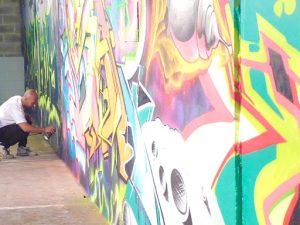
Street Art invades a luxury hotel in the Algarve
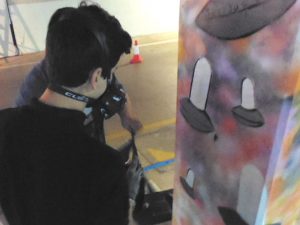
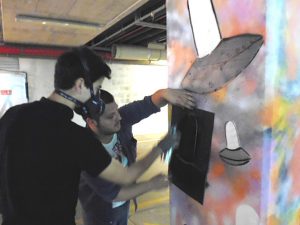
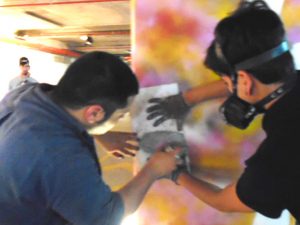
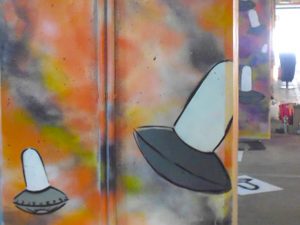
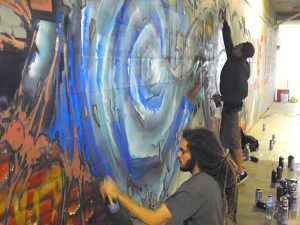
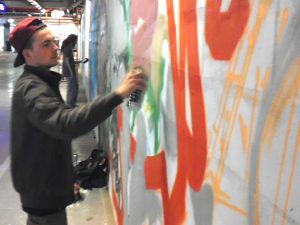
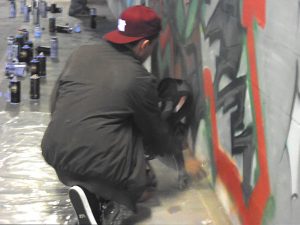
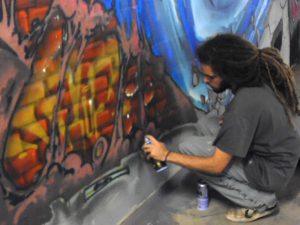
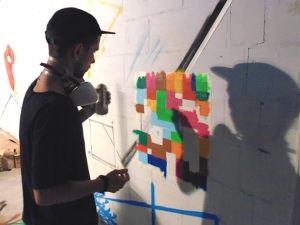
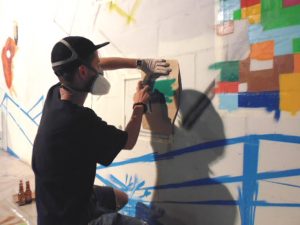
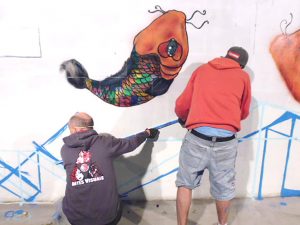
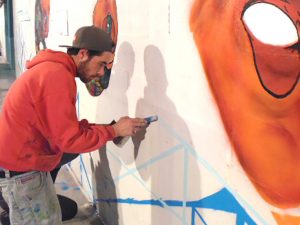
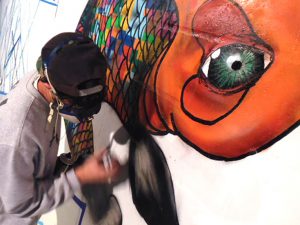
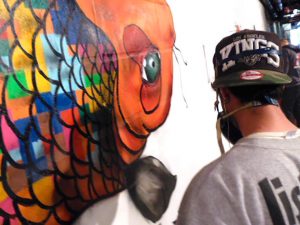
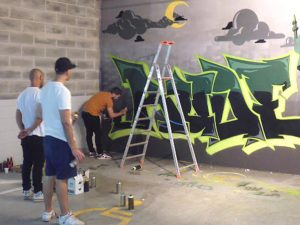
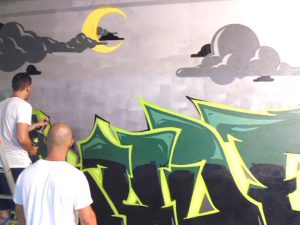
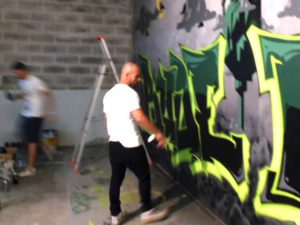
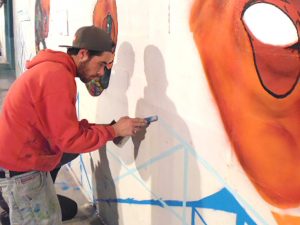
The event “Off the Wall”, organized by Galeria ArtCatto and by Hotel Conrad Algarve took the Street Art inside the hotel, one of the most exclusive and luxurious of the region. The idea, that might sound odd – artists used to work in the public space producing works in the hotel walls – resulted in an unusual program that involved guest artists and young artists from Escola de Belas Artes de Lisboa and from the Course in Artes Visuais of University of Algarve. For 3 days the artists worked in the areas selected by the organization and showed several techniques and attitudes involved in the production of wall paintings in cities throughout the world. Nuno Viegas, Leandro Marcos, Hélder Sousa, João Colucas, Leandro Cabrita, Adrian Costa and Vincent Ribeiro, young artists from the Course in Artes Visuais of UAlg, produced wall paintings with several techniques. The artists divided themselves between in sessions of group working, the trademark of some urban art, and also the presentation of individual works. These works either highlighted their belonging to the course, the apprenticeship of space and the exploration of diverse techniques, or they expressed their belonging to the urban context, an autodidact attitude, profoundly marked by the idea of occupying a territory that is usually closed to these type of artistic expression.
“Off the Wall” is an event that notoriously signals contemporaneity: after years of a more or less marginal existence, the urban art is recognized as an authentic artistic manifestation that belongs to the universe of Contemporary Art and, as so, deserves to be presented in a legitimate way, elevating the artists to the same rank as the one so far reserved to those artists that work inside walls. Urban art is not a recent activity. If one thinks of the overall human artistic productions, one can go back to the primitive paintings in rocks and cave walls and, thus, realize that the limitation of the artistic production to closed spaces is a relatively recent phenomenon in the History of the Western Art. However, by defining spaces to the artists’ production, the definition of what is or what is not considered art has been limited, leaving some phenomena, like street art, in a kind of limbo between art and vandalism, art and entertainment.
Urban arte is one of the many manifestations of the so-called Public Art, a concept that, all alone, causes some confusion. Using the urban space as an exhibition space is equivalent to taking the Art into the centre of everyday reality, making it penetrate the urban tissue without being confused with it, and it is also a sort of invasion of a space that is common property and where the artistic intervention may cause interferences in its everyday use by the public. Can every work placed outside be considered Public Art? Can this contemporary discovery of Street Art be under the risk of domestication and standardization? It is always a political attitude to intervene in the urban space, a territory marking attitude, or the consciousness of regaining a territory that should belong to everyone and where everyone could freely express their ideas. In Street Art there is a will to overcome limitations, to create new standards and to run away from imposed behaviours. The artist signals: ‘I exist and I don’t need curators, gallery directors, art historians or theorists to prove my existence. I belong to the space even before all of them manifest themselves. And the space belongs to all of them’.
The work of the artists from the Course in Artes Visuais in this event announces/reports this presence and the desire to create a personal iconography, not limited to what is learnt in classes, producing a mix between the art they breath and the art they aspire. Xana, artist and teacher, was the ideal curator. As an artist, he understood the needs of their pairs and as a teacher he supported every project allowed the students to shine through, each in his register, each with his technique.
The final result clearly shows that is possible to blend street art and luxury hotels. Or galleries. Because, in the end, as Gertrud Stein said, “a rose is a rose is a rose” – the art is the art is the art; what changes is just the support.
Mirian Tavares
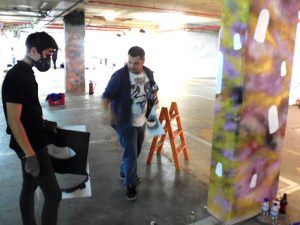
Organização: Galeria ArtCatto e Hotel Conrad
Participação: Artes Visuais – UAlg