PUBLICATION: SERIOUS PERVASIVE GAMES
The article “Serious Pervasive Games” signed by the researchers António Coelho (FEUP, INESC TEC), Rui Rodrigues (FEUP, INESC TEC), Rui Nóbrega (NOVA LINCS, INESC TEC), João Jacob (FEUP), Leonel Morgado (UAb, CIAC, & LE@D), Pedro Cardoso (FEUP, INESC TEC, FBAUP), Maria Van Zeller (FEUP), Liliana Santos (FEUP) e A. Augusto Sousa (FEUP, INESC TEC), was published in the section Human-Media Interaction of the journal Frontiers in Computer Science.
The article presents two case studies that explore concepts like pervasive learning, pervasive games, active learning, communication of science and games based on geolocation, problem-solving centred learning, analysing the benefits and problems in the education-learning process.
Abstract:
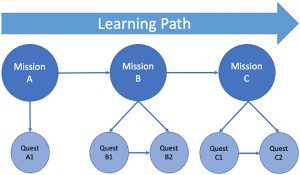
Serious Pervasive Games extend the magic circle (Huizinga, 1938) to the players’ context and surrounding environment. The blend of both physical and fictive game worlds provides a push in player engagement and promotes situated learning approaches. Space and time, as well as social context, acquire a more meaningful impact on the gameplay. From pervasive learning towards science communication with location-based games, this article presents research and case studies that exemplify their benefits and related problems. Pervasive learning can be defined as “learning at the speed of need through formal, informal and social learning modalities” (Pontefract, 2013). The first case study—the BEACONING project—aims to contextualize the teaching and learning process, connecting it with problem-based game mechanics within STEM. The main goal of this project is to provide the missing connection between STEM subjects and real-world interactions and applications. The pedagogical foundation is supported on problem-based learning (PBL), in which active learning is in the center, and learners have to work with different tools and resources in order to solve problems (quests). Teachers create, facilitate, and assess pervasive and gamified learning activities (missions). Furthermore, these quests are gamified in order to provide non-linear game plots. In a second case study, we demonstrate and evaluate how natural heritage can benefit from pervasive games. This study is based on a set of location-based games for an existing natural park, which have been developed in order to provide enhanced experiences, as well as additional information about some species that are more difficult to observe or that are seasonal. Throughout the research and development of these projects, we have encountered and identified several problems, of different nature, present in pervasive games.
The publication is available here