ROTURA MAGAZINE
THE NEW NUMBER OF ROTURA MAGAZINE IS NOW AVAILABLE
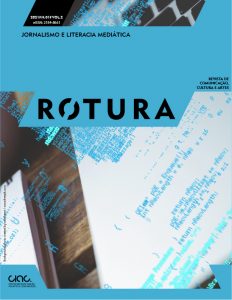
The third number of ROTURA – Revista de Comunicação, Cultura e Artes (Vol.2, N.1), from CIAC, is now available online. Under the title “Journalism and Media Literacy”, this is a thematic dossier that aims to establish bridges between journalism and media literacy, stimulate critical thinking regarding information and its quality and promote more conscious consumption.
“Journalism and Media Literacy” presents original research articles on professional journalism practices in the digital context; access to media and online information consumption; projects, actions and tools for the development of media literacy; quality practices, within the scope of informative media; and media literacy in the development of citizenship and democracy.
In “Covid-19 e desinformação como fenómeno global: Uma visão a partir do fact-checking”, Nuno Andrade Ferreira proposes an analysis of five news organizations dedicated to fact-checking, which develop their activity in Africa, North America, South America, Europe and Asia. In the article “Educação para os Media nas escolas: referências e recursos para professores”“, Mariana Bento Lopes and António Moreira situate us in the Portuguese education system, looking, namely, at the way media education is integrated in the Citizenship and Development subject. The issue of the quality of the information produced and conveyed by the media, and the service that should be provided to citizens, is one of the starting points of Nuria Sánchez-Gey Valenzuela’s article “Independencia política como parámetro de calidad en las elevisiones públicas: el caso de Canal Sur Televisión”. Mateo Brito-Beltrán and Ángel Torres-Toukoumidis sign “Análisis de la calidad de los medios digitales de Cuenca, Ecuador: el caso de las manifestaciones de 2019”, and identify, in this article, the role that digital media play in relevant political moments for society. In “Jornalismo e redes sociais: estímulos à competência midiática no Instagram Stories”, Leticya Bernadete Alexandre and Soraya Maria Ferreira Vieira analyze Drops, the news of the newspaper O Estado de S. Paulo in Instagram Stories that also has a presence on YouTube. Already in the article “Comida e informação para todos: as redes sociais podem contribuir para a aprendizagem social do sujeito?”, Bianca Maciente Colvara and Soraya Maria Ferreira Vieira analyze the Instagram profile of the Brazilian journalist Juliana Gomes, dedicated to healthy eating. Finally, “La rutina del entretenimiento misántropo en las series de televisión y películas mainstream contemporáneas: la evolución del pesimismo cultural desde Hobbes a HBO,” by Carlos Fernández-Rodríguez and Luis M. Romero-Rodríguez, points to questions about the relationship between literacies and audiovisual and cultural artistic production.
Under the direction of CIAC coordinators Mirian Tavares and Bruno Mendes da Silva, the third number of ROTURA was edited by CIAC researchers Ana Filipa Martins, Olivia Novoa Fernández and Susana Costa.
The next number, to be released in September 2022, will have “Cinemas Silenciosos em Portugal”[“Silent Cinemas in Portugal”] as its theme. The thematic dossier aims to contribute to the updating of studies related to the silent cinema period and to launch new tracks for a historiographical practice around cinema in Portugal. The call for papers runs until April 30, 2022.
There are accepted original articles (written in Portuguese, English, Spanish and French) that address the following topics: film exhibition spaces in the time of silent cinema; unique experiences of sound in exhibition (for example, the spoken tapes, musical accompaniment); production models in silent cinema; silent cinema in the Portuguese press (for example, the emergence of specialized magazines and commercial dissemination in the non-specialized press); critical reception during the transition from silent to sound; women in Portuguese silent cinema; foreign contributions to Portuguese silent cinema (for example, directors such as Maurice Mariaud); distribution of silent cinema in Portugal; restoration and digitalization of silent cinema in Portugal.