NEW PUBLICATION: THE FORKING PATHS
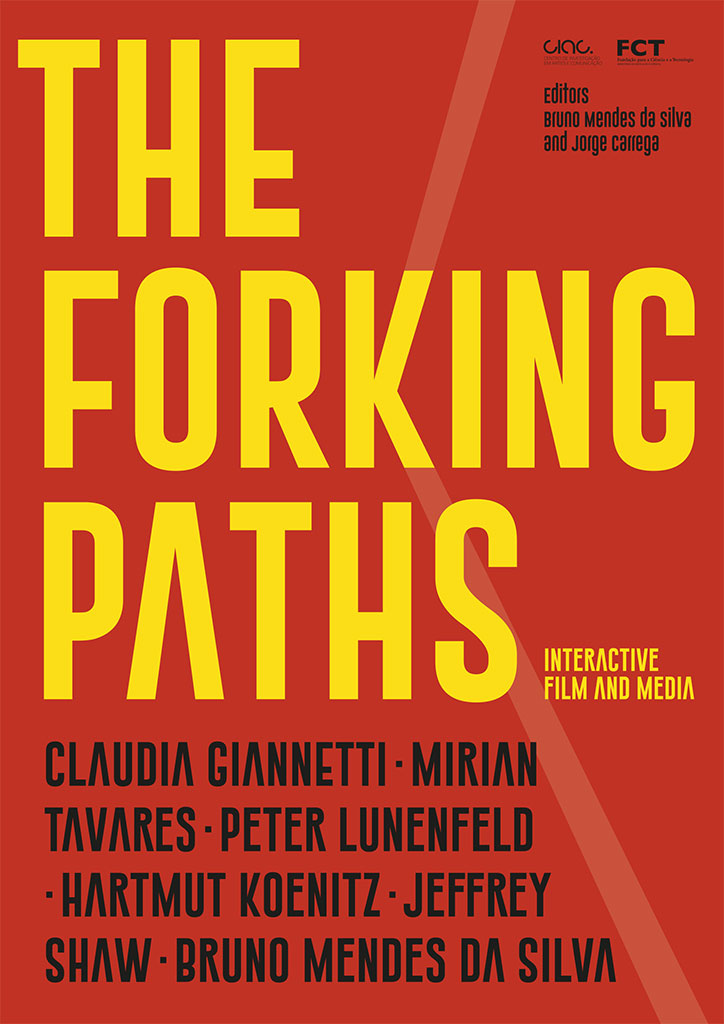
ELECTRONIC VERSION OF THE BOOK “THE FORKING PATHS” AVAILABLE ON THE CIAC WEBSITE
The Forking Paths: Interactive Film and Media is CIAC’s new book and, from today, is available on the Center’s website. By contextualizing and rethinking the young history of film and interactive media, this book points to a hypothetical future of cinema. CIAC vice-coordinator Bruno Mendes da Silva and researcher Jorge Carrega are the editors of this book.
The Forking Paths, a project by the Research Center for Arts and Communication (CIAC), began in 2013, when a group of researchers from the center began a theoretical and practical research process in the field of filmic interactivity. Since then, dozens of scientific publications have been written and the four interactive film experiences produced within the scope of the project featured in leading international festivals, such as FILE, in São Paulo, Brazil, or Script Road, in Macau, China.
In 2021, some of the world’s leading experts in interactive film and media join CIAC researchers. The result is the book The Forking Paths: Interactive Film and Media, which revisits historically, socially, pedagogically and aesthetically the last 50 years of audiovisual interactivity.
Claudia Giannetti introduces us to the precursors and the development of interactive audiovisual, from last century’s early 70s to the first decade of the current century. Jeffrey Shaw presents us with “Future Cinema”, a visionary text written precisely 20 years ago and now revised, a text which impresses by its timeliness and the way it remaps and redirects the history of cinema. Peter Lunenfeld writes about the enthralling multimediated project on immersion and pedagogy entitled “Colloidal Suspension: Immersion and the Pedagogies of Making”. In the chapter “Remediation or specificity? Interactive digital narrative and other interactive forms as continuation or new beginning”, Hartmut Koenitz opens an important discussion on the issue of conceptual framing of interactive digital narratives. Finally, the last chapter, written by CIAC researchers Bruno Mendes da Silva, Mirian Tavares, António Araújo and Susana Costa, relates filmic interactivity with surrealism and temporal perception, by presenting the project’s last interactive artifact, the Forking Paths: Cadavre Exquis, launched in 2019, and by contextualizing its production in the history of cinema and interactive film.
Although the morphological issues remain unaltered, hints that seem to indicate a possible evolution regarding audiovisual syntax are found in this book, whether due to the relativity of the concept of plan, which changes from objective to subjective by taking into account the possibility of multiple choices, or due to the multiple reinterpretations it offers to the idea of sequence.
The advent of artificial intelligence anticipates a possible rupture with pre-established contents related to the real image, thus enabling the emergence of a new generation of interactive films. Soon, viewers will be able to acquire creative powers that are beyond their control as well as beyond the control of the original author. We are talking about a generation of unpredictable content and film as a complete audiovisual experience.